
Quick Review:
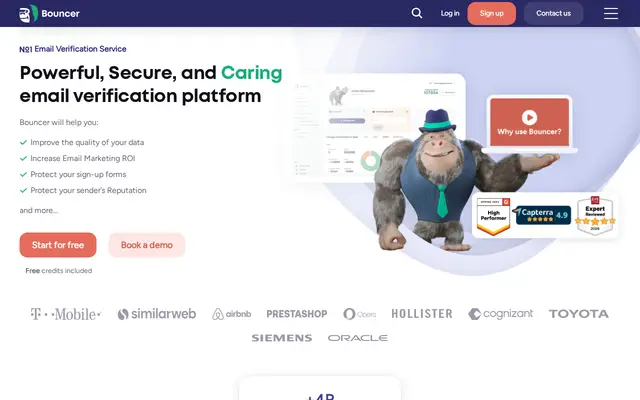
Bouncer is a solid email-verification service with clear pay-as-you-go pricing, starting at $8 for 1,000 checks, and credits that never expire. How useful it is depends on how you handle risky and unknown results.
- Best For
- Teams checking an authorized email list before sending.
- Starting Price
- $8 for 1,000 Verification ChecksChecked November 6, 2026.
Top 3 Pros
- A published minimum purchase and volume pricing table make budgeting easy.
- Credits never expire, which suits occasional list cleaning.
- The pricing page explains how duplicates and unknown results are charged.
Top 3 Cons
- Verification can't create permission or guarantee inbox placement.
- Risky and unknown results still need a decision from you.
- The quality guarantee doesn't refund a whole campaign or unused credits.
Deep Dive:
What It Is
An email-verification service for checking address deliverability signals, with separate deliverability-testing and form-protection products
How It Works
An operator checks a permitted list, reviews the result categories and decides how uncertain addresses should be handled under the organization’s policy. A deliverable result is a technical signal at the time of checking, not a promise that the recipient wants the message or that a later campaign will avoid spam filtering. The useful follow-up is monitoring actual failures and suppression records rather than repeatedly treating the same uncertain address as a fresh marketing opportunity.
Seen on Bouncer’s own product pages, help center and documentation, read November 6, 2026 (listed under Sources). We haven’t used Bouncer ourselves.
Key Features
- Bulk Email Verification
- Email Verification API
- Deliverability Result Categories
- Optional Recurring Credit Refill
- Separate Deliverability And Form-Protection Tools
Setup & Learning Curve
Start with a small authorized sample and decide how each result category will affect the mailing process before uploading a large list. Review the service’s data-handling terms and avoid transferring information the organization is not entitled to process. Preserve consent and suppression records outside the verifier. Check how unknown and duplicate results appear in the output, and confirm that any recurring refill is a deliberate budget choice rather than an unnoticed default. Before Committing: Use a permitted sample containing known duplicates and addresses your organization has already suppressed. Inspect each category and the charge for unknown results, then verify the import rules in the intended sending platform. Check whether refill is enabled before a paid purchase. This research did not transfer contacts, verify addresses or measure bounce rates.
Integrations
Bulk verification and API checks address different operational points. A form check can help screen a submitted address, but it does not establish the person’s identity or permission for every campaign. Verify how categories map into the existing email platform and whether a later import could restore a suppressed address. We did not upload contacts, call a verification API or send a message.
Support
Public reviews generally value the interface and pay-as-you-go flexibility while raising cost, risky-result interpretation and occasional inaccurate outcomes. We do not turn those reports or the company’s accuracy marketing into an independently measured success rate. The explicit guarantee is more useful when read narrowly: it addresses the verification fee for a qualifying wrong deliverable result, not lost campaign revenue or every mailing expense.
Real-World Use Cases
- Checking A Consented List Before A Planned Campaign
- Reviewing Uncertain Addresses For Manual Handling
- Evaluating Address Checks At A Signup Form
What It Costs
$8 For 1,000 Verification Checks, checked November 6, 2026
Prices checked November 6, 2026, from Bouncer’s own pricing page unless noted. Prices change often, so check the official page before you buy.
Check current pricing and plans on Bouncer’s official site →
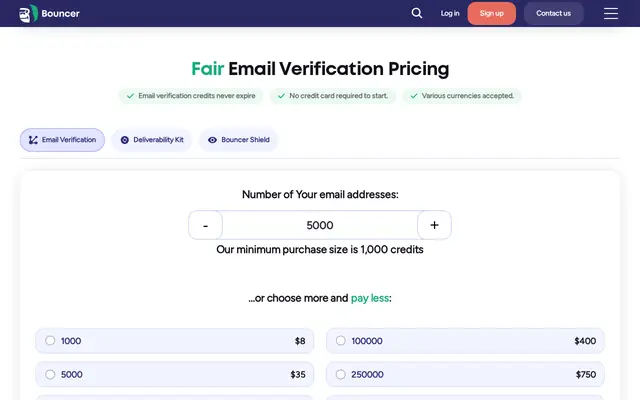
- Email verification starts at $8 for 1,000 checks, the minimum purchase. Larger packs are $35 for 5,000, $60 for 10,000, $250 for 50,000 and $400 for 100,000.
- You get 100 free credits with no card needed. Purchased credits never expire, and duplicate addresses and unknown results aren't charged. Automatic refills are optional.
- The Deliverability Kit is a separate product with its own monthly plans. Form protection and the API are priced separately.
What We Like
- A published minimum purchase and volume pricing table make budgeting easy.
- Credits never expire, which suits occasional list cleaning.
- The pricing page explains how duplicates and unknown results are charged.
What to Watch Out For
- Verification can't create permission or guarantee inbox placement.
- Risky and unknown results still need a decision from you.
- The quality guarantee doesn't refund a whole campaign or unused credits.
The Fine Print
- Purchases are generally non-refundable, and recurring subscriptions end at the close of the paid term when canceled.
- Bouncer's quality guarantee says that if an address marked deliverable clearly bounces within 72 hours of being checked, you can get a credit or refund for that check. Spam filtering and soft bounces aren't covered.
- Credits don't expire but are still prepaid, and optional automatic refills need to be canceled separately.
Who It’s Best For
Teams Checking An Authorized Email List Before Sending.
- Organizations that already have permission to email their list.
- Marketers who'll carefully handle deliverable, risky and unknown results.
Who Should Skip It
- Not a way to get consent or guarantee messages reach the inbox.
The Main Alternative
ZeroBounce Checked by Vetteroo
ZeroBounce, which we've also reviewed, is another email-verification service. Test the same list sample on both and compare how they label results, handle unknowns and what the total bill comes to.
What it costs: Free 100/mo; $39 for 2,000 credits, checked October 30, 2026
Read our ZeroBounce review.
Is It Right for You?
Pick Bouncer If You…
- need a set number of checks and like pay-as-you-go pricing.
- keep consent records and won't blindly email every result.
Pick ZeroBounce If You…
- already use ZeroBounce and understand its results.
- don't need a second verification service.
Our Take
Bouncer is a solid email-verification service with clear pay-as-you-go pricing, starting at $8 for 1,000 checks, and credits that never expire. How useful it is depends on how you handle risky and unknown results. Its quality guarantee is narrow, so don't treat it as a blanket refund.
Our review is a starting point, not the last word. Before you decide, see Bouncer’s own plan details and terms on its official site.
Side by Side
| Company | Best for | Starting price | Trial / refund |
|---|---|---|---|
| Bouncer Checked by Vetteroo | Teams Checking An Authorized Email List Before Sending | $8 For 1,000 Verification Checks | 100 No-Card Starting Credits; Narrow Quality Guarantee |
| ZeroBounce Checked by Vetteroo | Marketers who need to clean email lists before sending | Free 100/mo; $39 for 2,000 credits, checked October 30, 2026 | 100 free credits monthly |
Prices can change often. Check official pages for current prices.
What We Checked
- Bouncer's pricing, product pages and terms, read November 6, 2026
- Trustpilot, searched November 6, 2026 (no usable score for Bouncer)
- ZeroBounce's details: from our published review and its official pages, November 6, 2026
- The other official and outside pages listed under Sources (links checked November 6, 2026)
How We Researched
We researched Bouncer's official pricing, terms, product pages, help pages and outside reviews. We haven't used Bouncer ourselves, so this is a research-based review, not a hands-on test.
More in Email Verification & Deliverability
See All Reviews →Ready to Try Bouncer?
- $8 For 1,000 Verification Checks
Confirm the latest terms on the official site before you buy.
How We Review
We read the company's own terms, test the sign-up or booking steps where we can, and compare it with alternatives. A commission never changes what we write. Read our disclosure.