
Quick Review:
Yieldstreet, now called Willow Wealth, offers private-market investments with published minimums and fees.
- Best For
- Eligible accredited investors accepting private-market risk.
- Skip It If
- Emergency savings or anyone who wants an insured account or guaranteed yield.
- Starting Price
- Typical Initial minimum $5,000; Willow 360 $25,000Checked November 6, 2026.
Top 3 Pros
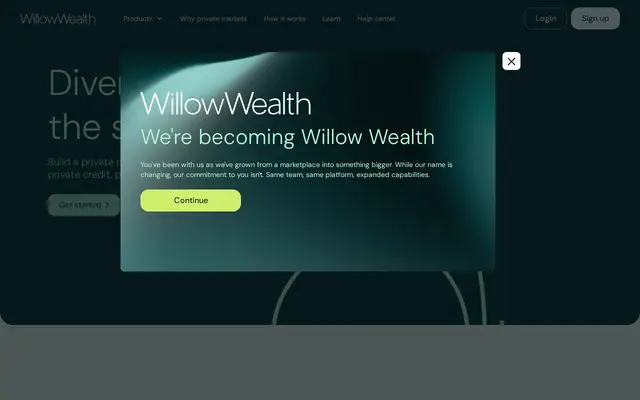
- The company explains its rebrand and says existing investments continue under their original terms.
- Willow 360 lists a specific $25,000 minimum plus separate advisory and expense fees.
- Its fee article warns that displayed returns can leave out the commitment fee.
Top 3 Cons
- Private investments can lose all their value and can be hard to sell.
- Fees and redemption rights differ from one offering to the next.
- The SEC disclosure settlement is a real trust concern.
Deep Dive:
What It Is
A private-markets investment platform now named Willow Wealth, offering individual opportunities, funds and managed portfolios across assets including real estate, private credit and private equity
How It Works
The relevant routine is reviewing investment documents, cash-flow updates and actual distributions against the original risk and liquidity assumptions. An app dashboard does not make private holdings as liquid as exchange-traded shares. A distribution may contain returned capital rather than profit. A sensible assessment keeps the investment’s term, fees, underlying assets and concentration visible together. The platform offers several asset classes, so it should not be described as exclusively a direct real-estate ownership service.
Seen on Yieldstreet’s own product pages, help center and documentation, read November 6, 2026 (listed under Sources). We haven’t used Yieldstreet ourselves.
Key Features
- Individual Private-Market Opportunities
- Real-Estate And Private-Credit Exposure
- Third-Party Evergreen Funds
- Willow 360 Managed Portfolios
- Portfolio Statements And Offering-Specific Documents
Setup & Learning Curve
Establish investment suitability and liquidity needs before considering any particular offering. Current account help requires an adult US person, a valid tax identifier, a US bank account and a US mailing address; particular investments have further eligibility requirements. Read the governing offering documents and fee schedule rather than relying on a projected-return card. We submitted no financial information, verified no accreditation, opened no account and moved no money. Before Committing: Compare the actual offering’s fee deductions, principal risk, redemption rights and concentration with the investor’s needs. Check whether distributions are income or returned capital and how the commitment fee affects the stated return. We made no investment, opened no account and tested no withdrawal.
Integrations
Current funding help describes investment-specific ACH and wire procedures and daily, weekly or monthly confirmation schedules depending on the offering. These are not an invitation to transfer funds to a generic brand-name beneficiary. A future investor must use verified instructions for the actual investment. We did not link a bank, request wire instructions or connect an investment account. Data aggregation, custody and underlying fund terms require their own review.
Support
A material trust issue is documented by the SEC, not inferred from anonymous reviews. In September 2023 the SEC announced settled charges against YieldStreet and its adviser for failing to disclose critical collateral risks in a $14.5 million offering. Without admitting or denying the findings, they agreed to cease and desist and pay more than $1.9 million in penalties, disgorgement and interest. That historical settlement is not a finding that every current offering is fraudulent, but a rebrand does not erase it or establish that present diligence is adequate.
Real-World Use Cases
- Researching A Long-Term Private Real-Estate Allocation
- Comparing Offering-Level Fees And Liquidity
- Assessing A Managed Private-Markets Portfolio Alongside Existing Holdings
What It Costs
Typical Initial Minimum $5,000; Willow 360 $25,000, checked November 6, 2026
Prices checked November 6, 2026, from Yieldstreet’s own pricing page unless noted. Prices change often, so check the official page before you buy.
Check current pricing and plans on Yieldstreet’s official site →
- Yieldstreet changed its name to Willow Wealth in November 2025; the company’s current May 2026 explanation says active investments continue under their original terms. This review retains the legacy company name so the review and application records stay matched, rather than treating the rebrand as a new unrelated business.
- Official help says initial investments typically begin at $5,000, with additional investment commonly in $1,000 increments; minimums vary by offering. Willow 360 has a $25,000 minimum, a stated 1.25% advisory fee and approximately 0.175% in expenses. These are US-market investment amounts and fees, not a subscription promising investment income.
- Other offerings have their own fee schedules and documents. The May 2026 commitment-fee explanation says an up-front fee is deducted from the investment and also applies to later top-ups. Displayed returns can exclude this one-time fee. Do not assume a historical platform-wide fee, an illustrative return or a target distribution is the amount actually earned. Official facts checked November 6, 2026.
What We Like
- The company explains its rebrand and says existing investments continue under their original terms.
- Willow 360 lists a specific $25,000 minimum plus separate advisory and expense fees.
- Its fee article warns that displayed returns can leave out the commitment fee.
What to Watch Out For
- Private investments can lose all their value and can be hard to sell.
- Fees and redemption rights differ from one offering to the next.
- The SEC disclosure settlement is a real trust concern.
The Fine Print
- Willow 360 says you can request distributions or start liquidating after one year, but that's not immediate full redemption; the same page warns of transfer limits, low liquidity and possible total loss. Each offering's documents govern.
- Minimums vary, and fees are disclosed for each offering. Newer offerings can have different fee structures from older ones, so don't assume one fee applies everywhere.
- Private placements aren't bank deposits or FDIC insured, and SEC registration doesn't mean the SEC approved an investment. Terms can run longer than estimated, and past or hypothetical returns aren't promises.
Who It’s Best For
Eligible Accredited Investors Accepting Private-Market Risk.
- Accredited investors with money they can set aside long term in private markets.
- People who can evaluate each offering and afford to lose some or all of their investment.
Who Should Skip It
- Not for emergency savings or anyone who wants an insured account or guaranteed yield.
The Main Alternative
Fundrise
Fundrise, which we've also reviewed, offers real estate and private-market investing too. Compare eligibility, how each fund is structured and how easily you can get your money out. Diversifying doesn't remove the risk of loss.
What it costs: No New Competitor Price Quoted
Is It Right for You?
Pick Yieldstreet If You…
- meet the eligibility rules and can assess each offering's documents yourself.
- are comfortable with long lock-ups, the fees and the company's history.
Pick Fundrise If You…
- want a different investment structure or can't tie up money long term.
- need insured savings, quick withdrawals or a guaranteed return.
Our Take
Yieldstreet, now called Willow Wealth, offers private-market investments with published minimums and fees. The big cautions are that your money can be tied up for a long time, costs vary by offering, and the company settled an SEC case over its disclosures. This is general information, not a recommendation to invest; read each offering's documents and consider independent advice.
Our review is a starting point, not the last word. Before you decide, see Yieldstreet’s own plan details and terms on its official site.
Side by Side
| Company | Best for | Starting price | Trial / refund |
|---|---|---|---|
| Yieldstreet Checked by Vetteroo | Eligible Accredited Investors Accepting Private-Market Risk | Typical Initial Minimum $5,000; Willow 360 $25,000 | Illiquid Investments; No General Money-Back Guarantee |
| Fundrise | Compare The Specific Workflow; Not An Identical Product | No New Competitor Price Quoted | Read The Applicable Current Product Terms |
Prices can change often. Check official pages for current prices.
What We Checked
- Yieldstreet's pricing, product pages and terms, read November 6, 2026
- Trustpilot, searched November 6, 2026 (no usable score for Yieldstreet)
- Fundrise's details: read on its official pages on November 6, 2026 (comparison only; not reviewed)
- The other official and outside pages listed under Sources (links checked November 6, 2026)
How We Researched
We researched Yieldstreet's official pricing, terms, product pages, help pages and outside reviews. We haven't used Yieldstreet ourselves, so this is a research-based review, not a hands-on test.
More in Real Estate Investing
See All Reviews →- DealCheck Vetteroo Our Pick
- FlipMantis Checked by Vetteroo
- Homesage.ai Checked by Vetteroo
- Lex Levinrad Real Estate Training Checked by Vetteroo
- The Real Deal Checked by Vetteroo
Ready to Try Yieldstreet?
- Typical Initial Minimum $5,000; Willow 360 $25,000
How We Review
We read the company's own terms, test the sign-up or booking steps where we can, and compare it with alternatives. A commission never changes what we write. Read our disclosure.