
Quick Review:
Doodle’s single-user Pro plan is $132 per year, with annual renewal, cancellation and published fourteen-day purchase-refund conditions.
- Starting Price
- Professional $132/year, or $15/month billed monthlyChecked November 7, 2026.
- Money-Back or Refund
- Published fourteen-day purchase-refund conditions.
Top 3 Pros
- Guests can join polls and book without paying or making an account.
- Annual subscribers can request a full refund up to 14 days after buying.
- A monthly option is available if you don't want to commit for a year.
Top Con
- Annual renewal and cancellation terms apply.
Deep Dive:
What It Is
Meeting polls, booking pages and sign-up sheets for finding times and coordinating groups
How It Works
No calendar was connected, no meeting was created and no participant invitation was sent. No account, subscription, trial, payment or integration was established. This is a documentary account of the selected offer rather than a claim to have measured scheduling speed or tested the organizer interface. It does not authorize booking time on anyone’s calendar or exposing participant information to a new service.
Seen on Doodle’s own product pages, help center and documentation, read November 7, 2026 (listed under Sources). We haven’t used Doodle ourselves.
Key Features
- What current Pro includes: The selected plan is for one person. The page separately describes Team as a multi-user option adding administrative and shared features, and Enterprise as a tailored higher-level arrangement. A one-user Pro license does not automatically include a Team administrator console, organization-wide analytics, enterprise identity controls, a bespoke uptime commitment or the ability to administer every colleague’s booking activity. General Professional help can discuss benefits spanning more than one paid plan. This review uses the current Pro-specific feature list to avoid transferring a Team or Enterprise capability into the selected license. No account was opened to test a feature gate, and no missing feature is invented merely because the public reader omits a numeric price in its interactive plan cards.
- Participants and organizer responsibilities: The premium FAQ says participants can join without paying or creating an account; the organizer is the person needing the paid plan for paid functionality. That can reduce participant friction, but no-account participation is not the same as no data processing or no contractual obligations. The actual terms define users broadly enough to include people participating without a paid subscription or registered account. The service may handle participant identities, contact details, time-zone information and connected calendar details depending on its use. An organizer should not interpret a public booking page as permission to collect every kind of personal information. No participant names, email addresses, availability preferences, health details or calendar records were uploaded during this research. The review does not invent consent from the people who might someday receive a link.
- Annual term and automatic renewal: The actual general terms describe a default twelve-month subscription beginning after full payment in advance and automatic successive twelve-month renewal unless terminated on or before the current term’s final day. That structure matches the annual plan selected here. A different monthly offer exists in public pricing, but this review does not use the annual default to redefine the unselected monthly plan or promise its exact account-specific contract. The terms say a subscription order is not binding on Doodle until written payment confirmation. No confirmation was received because no order was placed. The public offer and its applicable documentation can be evaluated without falsely claiming an active license. Price changes are described as applying after the current paid period, with notice and a choice not to renew, rather than retroactively repricing the already paid selected term.
- Cancellation stops renewal, not elapsed charges: The actual cancellation help describes turning off automatic renewal through the account’s Subscription section, confirming the cancellation and retaining paid access until the current term expires. The premium FAQ similarly says a canceled paid plan keeps its features to the end of the billing period and is not charged again. This is not a promise of a full unused-year refund whenever a subscriber stops needing scheduling software. Downgrading to the free version is described in the terms as effective after the agreed paid term, without refund of paid fees merely because of that downgrade. Canceling future renewal and requesting an eligible purchase-period refund are different actions. No settings were changed and no cancellation or refund request was submitted. The review did not test account navigation, confirmation delivery or support processing times.
- Fourteen-day purchase refund versus other remedies: The actual cancellation help says annual subscribers can request a full refund up to fourteen days after purchase. The current premium FAQ also publishes a fourteen-day right to cancel for every plan. This is not dismissed as irrelevant marketing: the general terms expressly incorporate the premium service description in full. The selected annual purchase exception is therefore documented alongside, rather than silently replaced by, the ordinary end-of-term downgrade rule. The terms separately discuss no remaining-period refund following some service changes, termination for breach or other specified circumstances. Those are different situations from the published fourteen-day initial purchase window. Their existence is not evidence of an unavoidable contradiction in the selected annual purchase remedy. The review also does not claim that the public refund statements waive every requirement or guarantee a particular support outcome. The monthly plan’s published prorated-refund discussion is not automatically an annual refund entitlement after the initial period. The review keeps that scope separate. No refund amount for an active subscription is calculated, no consumer-law conclusion for a particular country is given, and no legal notice was sent.
- Contract hierarchy is explicit: The actual terms establish an order of precedence: Subscription Confirmation, general terms, permitted-use policy, service-level agreement and privacy policy. That hierarchy is recognized; there is no invented claim that all documents have equal weight or that the agreement omits a conflict rule. A private subscription confirmation could matter to an actual purchase, but none exists for this research because no transaction occurred. The terms also explain that third-party integrations are separate applications and their use remains the user’s responsibility. A marketing list of calendar or video platforms is not a guarantee that every version, permission configuration or organization policy will work. No OAuth consent, calendar synchronization, video connection or API credential was created. The review does not certify an integration by merely reading its name.
- Data-processing documentation is not an audit: The included data-processing addendum distinguishes customer and Doodle roles, addresses lawful processing instructions, permits specified subprocessors and discusses transfers, retention, security measures and assistance. Those are contractual statements, not an independent inspection of production systems. The review did not read a confidential audit report, verify every security-control implementation or certify suitability for sensitive information. The addendum also describes situations where Doodle acts as a controller for its own relationship and operational purposes. That prevents oversimplifying the service as having only one role for every piece of information. A statement about certain service-provider restrictions should not be promoted into a blanket guarantee that no third party ever handles data. No customer dataset or calendar content was supplied.
- Plan comparisons and unsupported savings: The help page contains Team seat pricing and a lower summary whose units are not as clear as its main table. Those unselected Team details are not used to alter the one-user Pro annual amount. A two-seat minimum does not apply to the selected single-user plan, and a Team discount is not a selected Pro promotion. Enterprise’s annual starting amount and advanced controls likewise are separate. The current page’s claims that saved meetings or avoided no-shows can justify the price are vendor value propositions. This review did not measure administrative time, appointment revenue or reduced no-show rates. No promise is made that the subscription pays for itself or that it replaces every calendar-management workflow. Suitability depends on actual needs, permissions and behavior, none of which were assumed for an individual user.
Setup & Learning Curve
Documentary review only. No product installation, personal account configuration, device connection, reservation or purchase was performed. Verify the selected configuration and applicable conditions before acting.
Integrations
Only integrations or connections expressly described in the selected evidence are discussed. No account, calendar, device or household system was connected or tested.
Support
The actual general terms describe a default twelve-month subscription beginning after full payment in advance and automatic successive twelve-month renewal unless terminated on or before the current term’s final day. That structure matches the annual plan selected here. A different monthly offer exists in public pricing, but this review does not use the annual default to redefine the unselected monthly plan or promise its exact account-specific contract. The terms say a subscription order is not binding on Doodle until written payment confirmation. No confirmation was received because no order was placed. The public offer and its applicable documentation can be evaluated without falsely claiming an active license. Price changes are described as applying after the current paid period, with notice and a choice not to renew, rather than retroactively repricing the already paid selected term. The actual cancellation help describes turning off automatic renewal through the account’s Subscription section, confirming the cancellation and retaining paid access until the current term expires. The premium FAQ similarly says a canceled paid plan keeps its features to the end of the billing period and is not charged again. This is not a promise of a full unused-year refund whenever a subscriber stops needing scheduling software. Downgrading to the free version is described in the terms as effective after the agreed paid term, without refund of paid fees merely because of that downgrade. Canceling future renewal and requesting an eligible purchase-period refund are different actions. No settings were changed and no cancellation or refund request was submitted. The review did not test account navigation, confirmation delivery or support processing times. The actual cancellation help says annual subscribers can request a full refund up to fourteen days after purchase. The current premium FAQ also publishes a fourteen-day right to cancel for every plan. This is not dismissed as irrelevant marketing: the general terms expressly incorporate the premium service description in full. The selected annual purchase exception is therefore documented alongside, rather than silently replaced by, the ordinary end-of-term downgrade rule. The terms separately discuss no remaining-period refund following some service changes, termination for breach or other specified circumstances. Those are different situations from the published fourteen-day initial purchase window. Their existence is not evidence of an unavoidable contradiction in the selected annual purchase remedy. The review also does not claim that the public refund statements waive every requirement or guarantee a particular support outcome. The monthly plan’s published prorated-refund discussion is not automatically an annual refund entitlement after the initial period. The review keeps that scope separate. No refund amount for an active subscription is calculated, no consumer-law conclusion for a particular country is given, and no legal notice was sent. The actual terms establish an order of precedence: Subscription Confirmation, general terms, permitted-use policy, service-level agreement and privacy policy. That hierarchy is recognized; there is no invented claim that all documents have equal weight or that the agreement omits a conflict rule. A private subscription confirmation could matter to an actual purchase, but none exists for this research because no transaction occurred. The terms also explain that third-party integrations are separate applications and their use remains the user’s responsibility. A marketing list of calendar or video platforms is not a guarantee that every version, permission configuration or organization policy will work. No OAuth consent, calendar synchronization, video connection or API credential was created. The review does not certify an integration by merely reading its name.
Real-World Use Cases
- No calendar was connected, no meeting was created and no participant invitation was sent. No account, subscription, trial, payment or integration was established. This is a documentary account of the selected offer rather than a claim to have measured scheduling speed or tested the organizer interface. It does not authorize booking time on anyone’s calendar or exposing participant information to a new service.
What It Costs
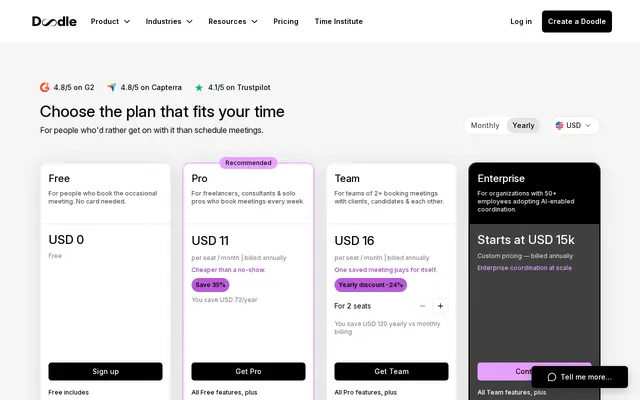
$132/year or $15/month (Pro, one user), checked November 7, 2026
Prices checked November 7, 2026, from Doodle’s own pricing page unless noted. Prices change often, so check the official page before you buy.
Check current pricing and plans on Doodle’s official site →
- Pro for one user is $132 a year, or $15 a month billed monthly (checked November 7, 2026).
- Team and Enterprise plans are priced separately.
What We Like
- Guests can join polls and book without paying or making an account.
- Annual subscribers can request a full refund up to 14 days after buying.
- A monthly option is available if you don't want to commit for a year.
What to Watch Out For
- The yearly plan renews automatically for another 12 months unless you cancel by the last day of your term.
- Pro is for one person; shared and admin features need Team or Enterprise.
- Canceling stops renewal, but you won't get money back for time already used after the refund window.
The Fine Print
- Cancel by turning off auto-renewal in your account's Subscription section. You keep paid access until the current term ends.
- Doodle's premium FAQ also lists a 14-day right to cancel on every plan.
- Doodle's data-processing addendum covers how it handles your data, subprocessors and transfers.
Who It’s Best For
Only the specifically documented product or plan.
- People who schedule lots of meetings and want guests to respond without signing up.
- Solo organizers who don't need team admin features.
Who Should Skip It
- Not for teams that need shared admin tools, which are on the Team plan.
The Main Alternative
Calendly
Calendly, which we've also reviewed, is another popular scheduling tool. Compare how each handles booking links versus group polls, the features on each plan and how much you'd pay for one user.
What it costs: Free; Standard $10/seat/mo yearly ($12 monthly), checked October 30, 2026
Is It Right for You?
Pick Doodle If You…
- schedule often and want guests to respond without an account.
- are a single organizer who's happy with yearly or monthly billing.
Our Take
Doodle Pro is a single-user scheduling plan for $132 a year, or $15 a month billed monthly. People you invite can respond without paying or creating an account. The yearly plan renews automatically, but annual subscribers can get a full refund within 14 days of buying.
Our review is a starting point, not the last word. Before you decide, see Doodle’s own plan details and terms on its official site.
Side by Side
| Company | Best for | Starting price | Trial / refund |
|---|---|---|---|
| Doodle Checked by Vetteroo | Only the specifically documented product or plan | $132/year or $15/month (Pro, one user) | See actual applicable purchase conditions and warnings below |
| Calendly | Teams that want the most widely used booking-link tool | Free; Standard $10/seat/mo yearly ($12 monthly), checked October 30, 2026 | Free plan |
Prices can change often. Check official pages for current prices.
What We Checked
- Doodle's pricing, product pages and terms, read November 7, 2026
- Trustpilot, searched November 7, 2026 (no usable score for Doodle)
- Calendly's details: read on its official pages on November 7, 2026 (comparison only; not reviewed)
- The other official and outside pages listed under Sources (links checked November 7, 2026)
How We Researched
We researched Doodle's official pricing, terms, product pages, help pages and outside reviews. We haven't used Doodle ourselves, so this is a research-based review, not a hands-on test.
More in Scheduling & Calendar Apps
See All Reviews →- SimplyBook.me Vetteroo Our Pick
- YouCanBook.me Vetteroo Our Pick
- Akiflow Checked by Vetteroo
- Appointlet Checked by Vetteroo
- Cal.com Checked by Vetteroo
- Calendesk Checked by Vetteroo
- Lunacal Checked by Vetteroo
- Morgen Checked by Vetteroo
Ready to Try Doodle?
- $132/year or $15/month (Pro, one user)
How We Review
We read the company's own terms, test the sign-up or booking steps where we can, and compare it with alternatives. A commission never changes what we write. Read our disclosure.